CategoriesLifestyle

The Myth of Self-Reliance: Why True Resilience Is Only Found in Community

The term self-reliance brings to mind a lone homesteader living off-grid in a home built with reclaimed materials. They harvest their rainwater; capture and store energy with a solar panel and a battery; and grow and preserve their own food. They may have a wood stove to cook and heat their home with, and have probably amassed a lot of tools and equipment (a freezer, an axe, canning jars) to enable their lifestyle.

This is an admirable feat, but in reality, this brave soul will never be completely self-reliant because of their hidden dependencies: at some point a company manufactured those upcycled building materials, solar panel and battery, and all the other equipment this off-gridder relies on. Even if they were to “reset the self-reliance clock” once everything needed for this lifestyle is obtained, complete self-reliance has a shelf life. The freezer may short out, canning jars may break, appendicitis may strike. 

This individual may have a lot of knowledge, tools and skills, but they don’t have all of them. 

Does this mean we should abandon our self-reliance goals? Not at all. Instead, it’s important to understand that true self-reliance, paradoxically, is only possible through interdependence with others.

One of the 12 permaculture principles is “Integrate Rather Than Segregate,” or to foster connections between elements (including humans!) to increase synergy and efficiency. Humans are inherently social beings who thrive in collaboration. A functional, connected community shares resources, distributes labour, and collectively tackles challenges. This model mirrors nature, where ecosystems rely on diverse species working together for mutual benefit. One community member might specialize in gardening, while another provides carpentry or medicinal knowledge. Together, they create a resilient and sustainable network that no individual could achieve alone.

By building relationships, sharing resources, and fostering cooperation, we can create resilient communities that allow everyone to flourish. True self-reliance isn’t about isolation; it’s about embracing the power of connection.

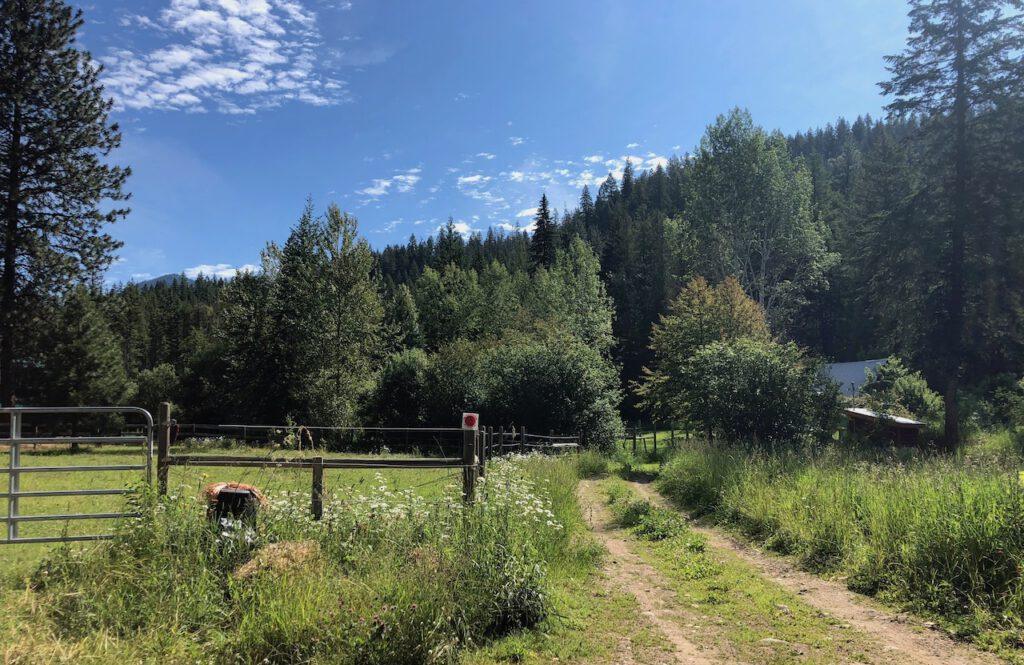
sunny morning view of a homestead driveway and paddock
CategoriesLifestyle

We Found It!

Last summer, my husband and I went on our second road trip across B.C. to look at properties. We knew we wanted to get closer to nature and become more self-reliant, but didn’t have many plans beyond that. The goal of the trip was to decide where in B.C. we wanted to move.

We fell in love with the Slocan Valley. It’s perfectly situated between our beloved Nelson and the up-and-coming Nakusp we just discovered, with beautiful views and the most down-to-earth people (though we found those throughout our travels).

One of the properties we saw, near Winlaw, really stood out to my husband. He saw its potential immediately: it’s unzoned, has two water sources, and a cleared area that could be used for a variety of purposes. I was skeptical as the main residence, a cabin, needed some work, but he couldn’t shake the desire to pursue it. Fortunately, it was still on the market when we decided to act.

The pandemic had a major impact on my outlook: it eliminated all of my doubts. It wasn’t until I witnessed the faltering supply chains that I realized how vulnerable we were. It was then that I saw the property, and it’s potential to make us more self-reliant, as a lifeline. The pandemic made me see the need and permaculture made me see the way.

We are set to close at the end of the month. I know there is a ton of work to do to get the property to where we want it to be. I also know it will be harder than I think. But, for us, it’s the only option.