
Thanks to our new friends at the Upper Columbia Cooperative Council (via the BCCA), we received a copy of this excellent 2025 Abacus Data report on how uncertainty over the last several years has become a lived experience.
If you’ve been feeling your anxiety rise along with grocery prices, geopolitical tempers, and AI consequences, the numbers here confirm that you’re not alone – especially if you’re in the middle class.
“After several years of repeated shocks, instability is no longer just a political or economic concept. It has become the backdrop of everyday life.”
But the report isn’t just a diagnosis of what’s broken. It reveals a huge, hopeful shift in how Canadians want to build a more secure future.
“Canadians are remarkably aligned on what stability actually means. They do not define it narrowly as quarterly growth or abstract economic performance. They define it in human terms: secure homes, strong communities, more shared power, and a greater say in the organizations that affect their lives.”
This is the main reason behind Big Calm’s recent shift to becoming a cooperative. Our transition isn’t just a structural change on paper – it is a direct, practical response to the growing cry for stability. By organizing our Phase 2 as an equity housing co-op, we are building a pocket neighbourhood where the community members are the ones who actually co-own the land, hold the equity, and democratically control their environment.
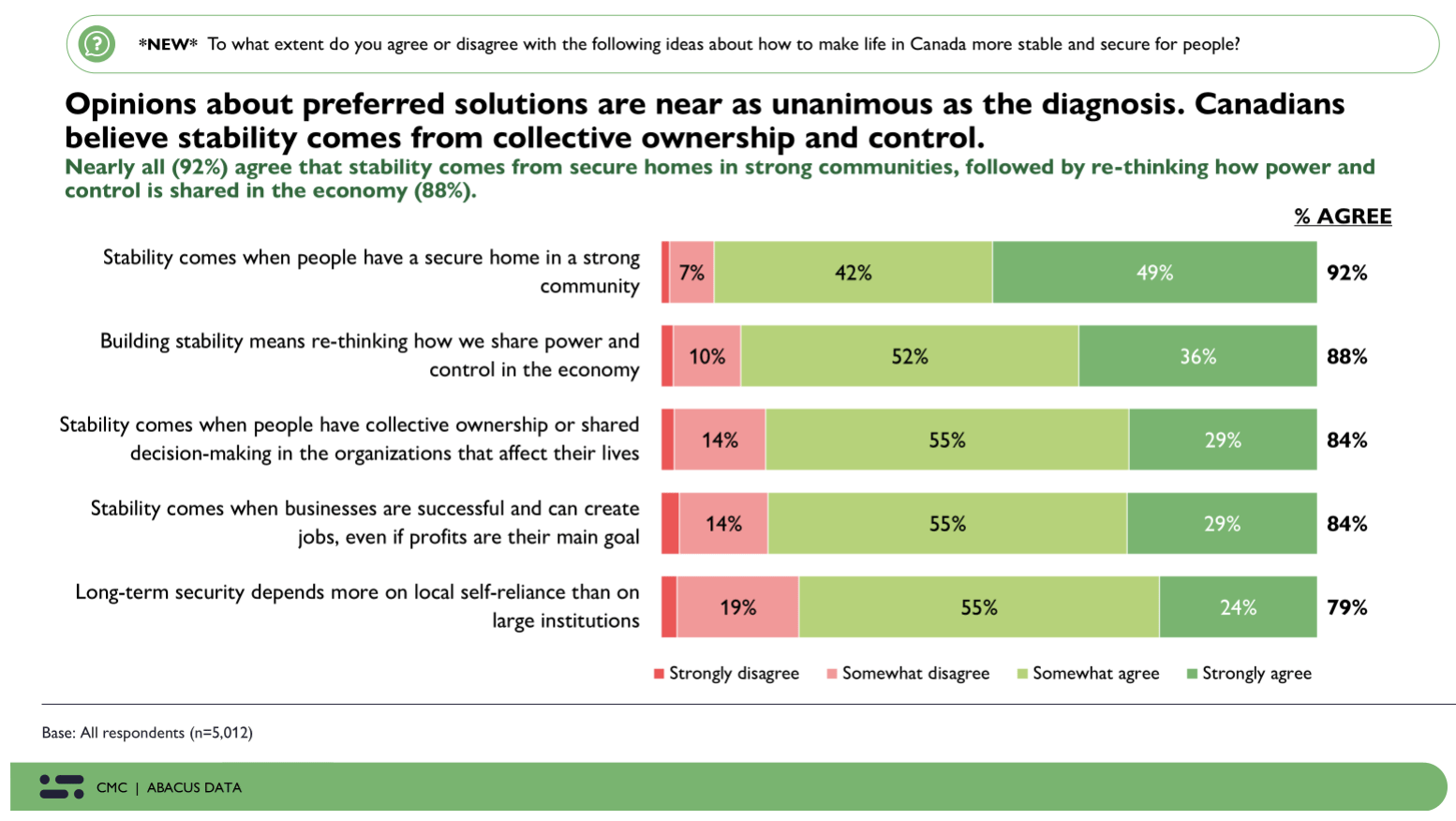
The larger takeaway from the report…
“In 2019, the phrase ‘the age of uncertainty’ captured a growing unease. [Today], that same phrase feels even more apt. But the new research also shows why the co-operative story is ultimately a hopeful one. Even in a more anxious and fragmented environment, Canadians have not given up on the idea that institutions can be fairer, more collaborative, and more grounded in the needs of real people.
“That is where co-operatives stand apart. They do not ask Canadians to choose between economic resilience and community wellbeing, between innovation and accountability, or between individual need and collective strength. At their best, they bring those things together. They offer stability not by concentrating power, but by sharing it. They offer resilience not by distancing themselves from communities, but by investing in them. And they offer a path forward that feels not only credible, but timely.
“If the challenge facing Canada today is how to build a more secure life in a less secure era, then the case for co-operatives is stronger than ever. They are not simply relevant to this moment. They are built for it.”