Black and white photo of a couple in a field of flowers
CategoriesDevelopment

Big Calm in the Valley Voice

One of the things that drew us to the Slocan Valley was the local spirit and “real world” news conveyed every two weeks in the Valley Voice newspaper. It was a welcome reprieve from the 24/7 US political coverage and the social media doom-scrolling predominant in the rest of our media exposure. Each issue, every two weeks, was/is a treat.

And now Big Calm is featured in it! You can find us in the July 1, 2021 issue on page 6 in an article by John Boivin titled, “New developments see future in tiny homes, communal living”.

A Slocan Valley couple is hoping their new housing development will attract high-tech workers and others looking for a simpler life.


And their project is only one of several that are looking to launch a new generation of alternative community living in the region.


“The tiny homes will be spaced out along this ridge here,” says Steve Hardy, pointing across a field of white and yellow sub-alpine flowers. “We want to give each unit lots of space.”


Hardy and his partner Abby gave the Valley Voice a tour of their 37-acre property recently. They purchased the acreage between Slocan City and Winlaw two years ago, after getting disillusioned with life in Calgary.


“We were making regular trips to the Kootenays and Okanagan, seeing what each place had to offer, the culture of each area, and we kept coming back to the Slocan Valley,” says Steve Hardy. “We liked the charm, the locals we met, the beauty of the area. And then we found a piece of property that we thought would be a great pocket neighbourhood for people who could work remotely and would like to do so in a nice place.”


The pandemic just reinforced their determination to try to find a new way of life. And they figured others shared their vision.


There wasn’t much on the property: an old cabin that has to be torn down, a second that needs major overhaul*, and some fencing. But there is an organic garden, spring water, spectacular views, and a cool breeze not felt on the valley bottom on a hot day. Out of a somewhat unremarkable piece of property on the east slope of the Slocan Valley, however, they hope to create something special.


They call it ‘Big Calm,’ a “permaculture-guided tiny homestead community for remote digital workers,” in the heart of the Kootenays.


“It’s a fairly modest community, within the natural landscape of the property,” says Hardy. “The majority would be long-term renters, and a couple would be guest stays.”


The Big Calm Tiny Homesteads website outlines the project’s scope. “ We envision an ecologically sustainable, self-reliant tiny home community guided by the ‘Earth Care, People Care, Fair Share’ ethics of permaculture; and strengthened by collaboration, mutual support and the diversity and skills of its members,” it says. “Hands-on work is a feature, not a bug.”


There’s no shortage of hands-on work to do. Before the first community member arrives, the concrete pads for 10 tiny homes have to be poured**, and utilities like water and electricity hooked up. The septic system is going to be top-of-the-line when it’s installed, but the last part of that project’s been delayed by red tape and supply problems.


It’s a complicated bit of development for two admitted amateurs, who are managing the building project while trying to attract residents and investors in a timely manner. But Hardy says it’s going well.


“Most of the development will take shape next year, and we’re currently putting out an investment raise – dividend-producing shares so that we can accelerate the build actually. Our business plan was perhaps too conservative. The interest is certainly there to fill the spots as we can build them.”


The Hardys hope to welcome their first tenant in the fall. That person has already purchased a tiny home for placement on the property.


It won’t be cheap to be a resident of Big Calm. At $1,500 a month for pad fees*** – which includes utilities – the Hardys are working to attract upscale, higher-income knowledge workers like themselves. Steve ran a software company and now consults high-tech start-ups, while Abby is a communications specialist for biotech companies.


They plan to build Big Calm to allow residents to live the Slocan lifestyle, while still earning a good living.


“This has been one of the best parts of the process for us, the people who have been reaching out to us because they are interested,” he says. “It’s from all across the country and the US.


“We have geochemists, social innovators, arts fundraisers… all across the board. But they all have a similar appreciation of wanting to make a smaller footprint in a nice natural location and still be able to effectively do their jobs.”


The Hardys have been surprised by the potential for communities like this to help grow the local economy.


“There’s actually quite a pent-up demand for it. Our sense is it’s an enormous economic development opportunity for the valley… it’s people with a commitment to the local area, who bring a net income from outside because they already have their jobs from elsewhere.”


Alternative options growing

The pandemic has created a wave of people moving out of the cities to places like the Slocan Valley. But that’s driven up house and land prices significantly, and only the well-financed can afford to buy or build these days.


That’s what’s made places like Big Calm Tiny Homesteads attractive to some. Offering a small space for a tiny home or RV, sharing the cost of services and supporting each other in a community has become an appealing idea.


Similar projects are starting or being contemplated along the valley, aimed at a more local audience.


“Off-the-grid site rental available in exchange for work trade outside of Slocan City,” a post advertised on Facebook recently read. “… We are asking for 30 hours a month in exchange for the site.”


With 150 acres on Perry’s Ridge, the developer plans to create a 15- to 20-unit permaculture community on part of the property.


While the Hardys across the valley work with contractors and hope to attract higher-income residents, this developer is pulling his project up by its bootstraps, offering space for people with chainsaw and other skills to build the community themselves.


“Skills with building, energy systems and all trades are desirable at this phase,” the post says. “Long-term, the community will require skills with permaculture, agroforestry, livestock management, medicine making, fibre arts, practical crafts, communication, facilitation, etc.”


The post makes no bones about what’s involved.


“We are looking for hardy folks to help us pioneer this effort. Experience roughing it is required,” it notes.


The post says they hope to have six sites ready for occupancy with tiny homes or RVs by this winter. Eventually a community centre will be built on site, with a kitchen, bathing and laundry facilities. The dream is to run the community as a co-op.


The carrot is building a community with others who share the same values.


“We are a group of people passionate about eco-villages, healing nature, and the arts. Looking for other passionate and inspired folks who are open-hearted and openminded,” the post says.


The developer declined to be interviewed by the Valley Voice at this time, saying after the original post he was inundated with inquiries. Other projects are popping up along the Valley and elsewhere in the West Kootenay. In Winlaw, the Raven’s Perch offers a single vacation unit at this time, but has plans to “build more space on the property to live and work.”


The pitch the Winlaw property makes has a familiar ring: “We’re creating an environment that encourages those who visit to reconnect with nature – the forest, lakes, rivers and mountains,” their website says. “We encourage visitors to disconnect from the outer world reality so that they might reconnect with their own nature.”


History repeats

A century ago, cheap land and a desire to live communally brought thousands of Doukhobors to the region; counterculture hippies and draft dodgers 50 years later established communes across the valley (there’s even an old one neighbouring the Hardys’ property).


The drivers may be different today – concerns about climate change, the cost of housing, and technology enabling remote work – but the attraction is the same: a desire to live in peace, in beauty, and in support of each other.


But just like past immigrants, the newcomers bring the promise of both change and growth.


“The type of people being attracted to the pitch we have would be great additions to the community; they share the values that are already here,” says Steve Hardy, who notes jurisdictions like Nova Scotia have whole campaigns devoted to attracting those kind of workers.


“I don’t’ think it’s fully set in how amazing this opportunity can be and how strong a contributor these folks would be, and how much they want to be kind of outside of the fray.”


Despite modern trappings, some things don’t change.

A few corrections/clarifications to the original reporting:
*Not an overhaul but rather simply the completion of a previously unfinished structure.
**The pads will be permeable gravel, not concrete.
***Please see our FAQ for more current and detailed pricing info.

Photo: John Boivin
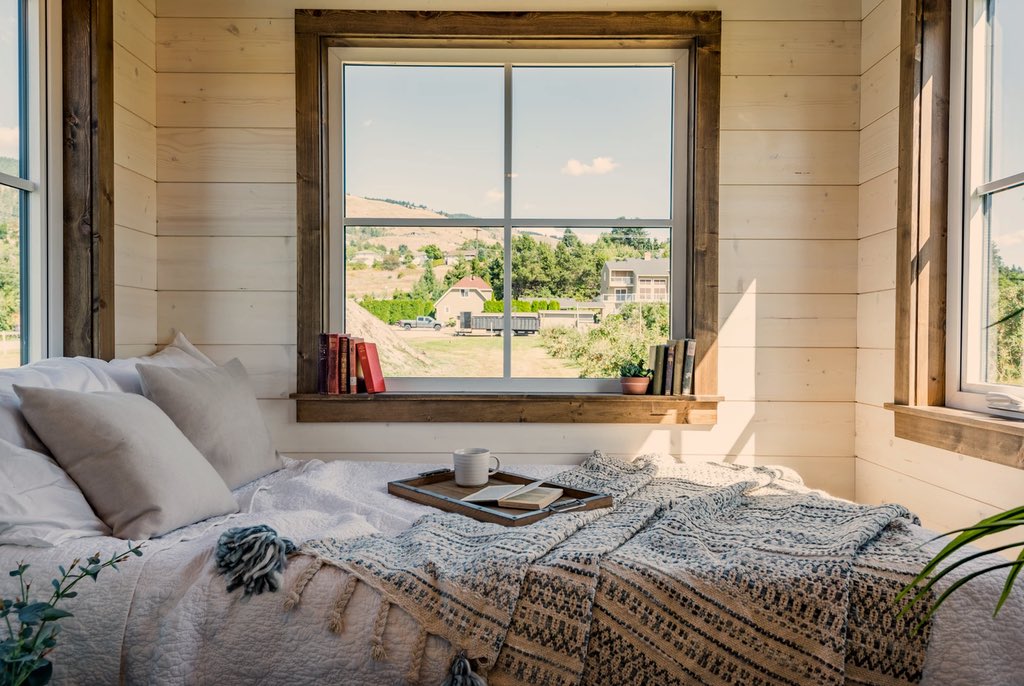
tiny house bedroom with farm outside window
CategoriesLifestyle,  Tiny Homes

Tiny Houses for Mature Audiences

When we first conceptualized Big Calm, we figured it would appeal to individuals and couples purchasing their first home. We were thrilled to learn that middle-to-retirement age folks are actually the demographic group that find tiny homestead living particularly appealing. Whether downsizing after children have grown up and moved out, or looking for a nice place to retire, tiny homestead living is capturing the interest of Baby Boomers and GenXers!

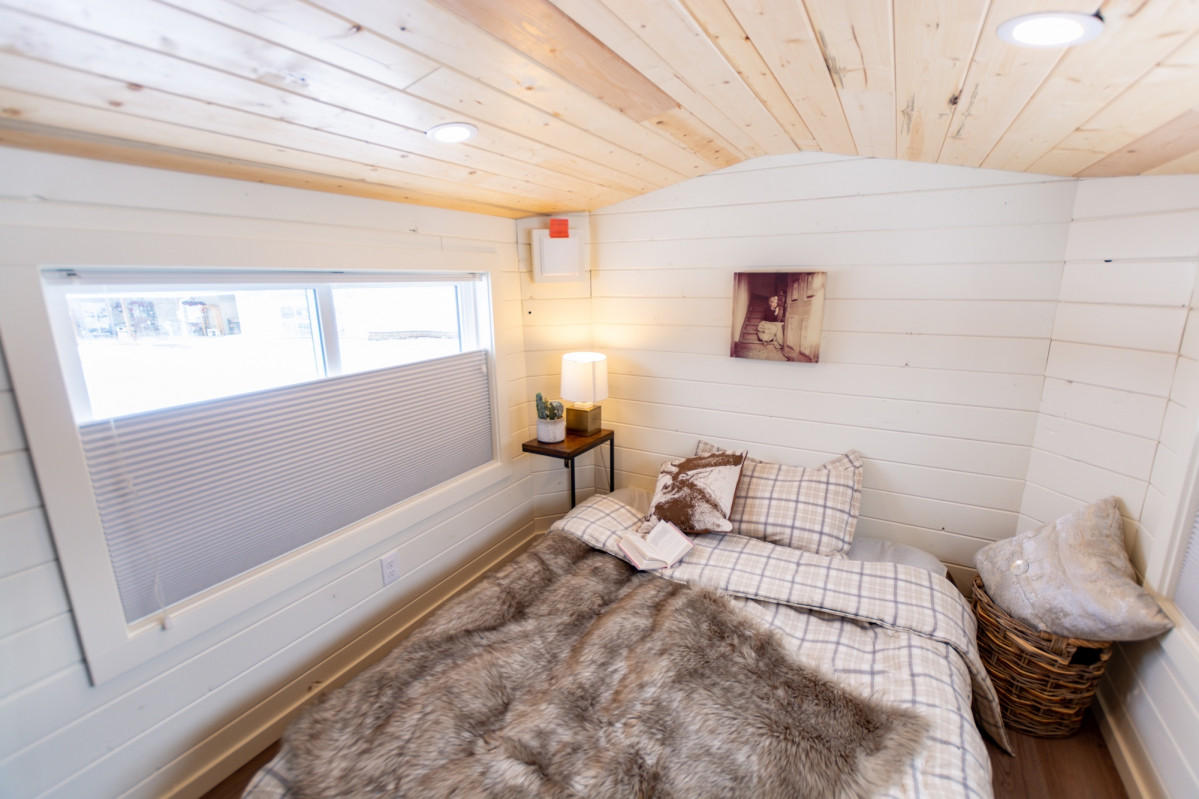
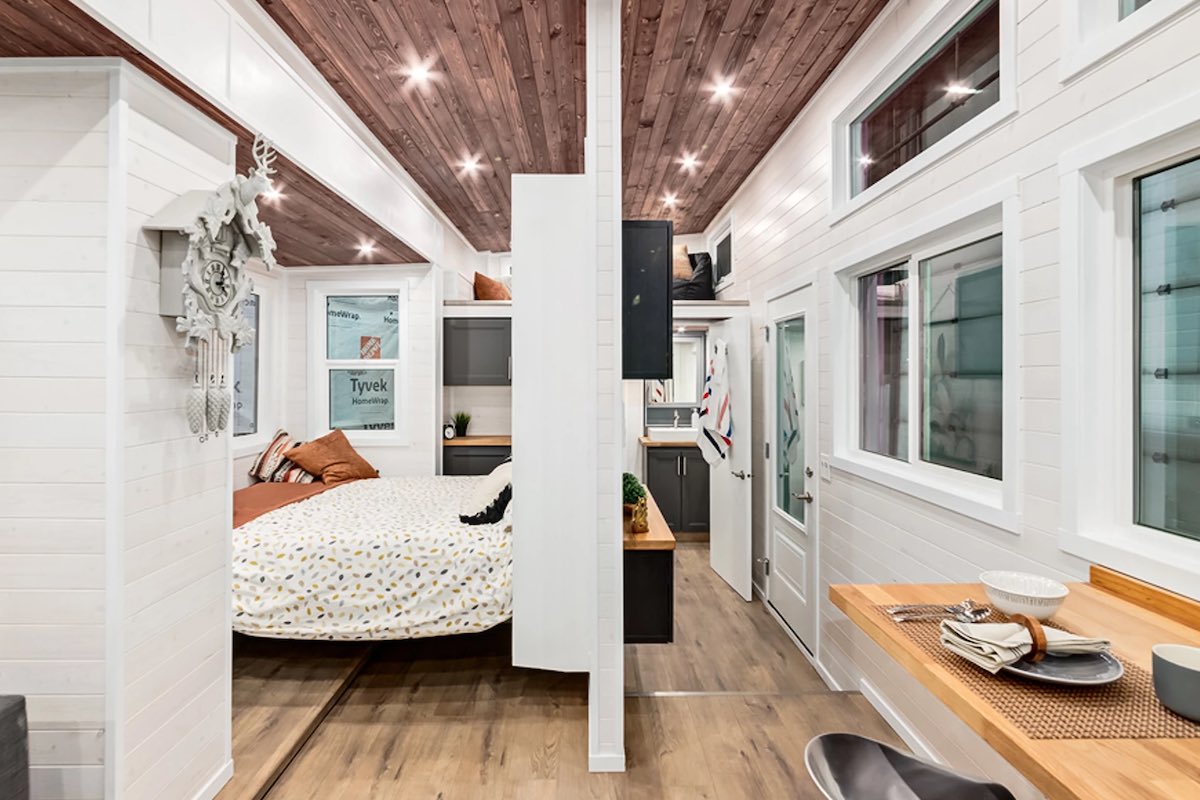
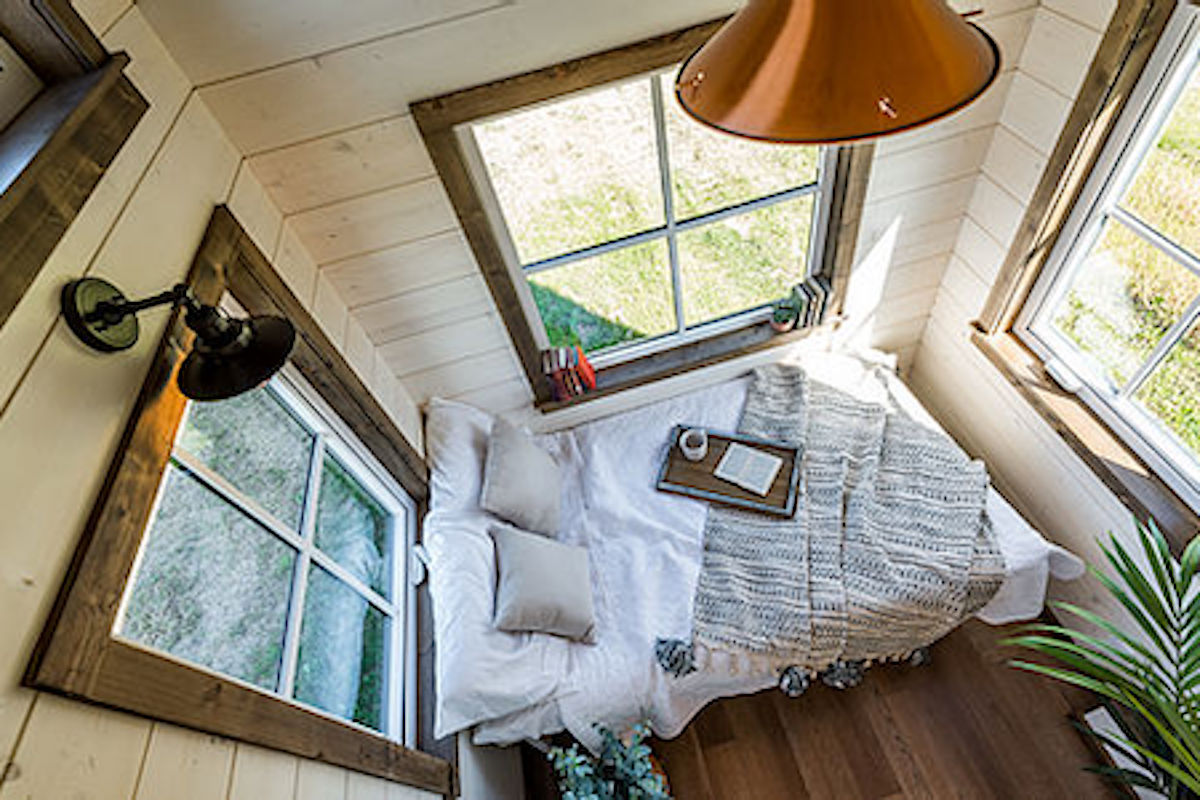
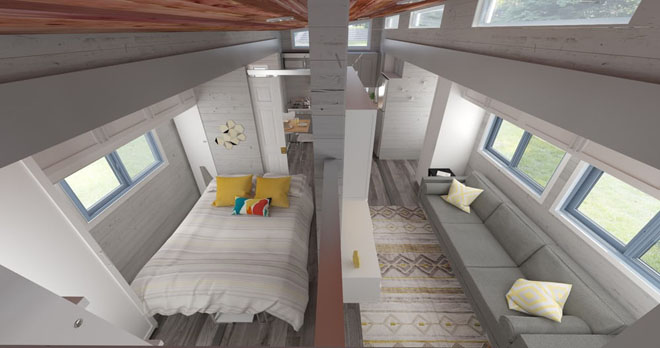
We’re no spring chickens ourselves, so we can relate to tiny home living hesitancy as it seems the majority of tiny home sleeping arrangements involve lofts. But, many builders are catching on that main floor bedrooms are the way to go for many clients. We’ve compiled a list of builders that offer this feature, or are willing to work on custom builds to ensure their clients’ comfort:

Builders with main floor bedroom models:

Tiny house bedroom interior
Teacup Tiny Homes

The Phoenix – storage staircase to master bedroom with standing room
Summer’s Night Dream – main floor bedroom
The Margo – main floor bedroom

Tiny house interior
ZeroSquared

Van Gogh – main floor queen bedroom
Aurora – main floor queen bedroom
Maverick – two main floor queen bedrooms

Tiny house bedroom interior
Summit Tiny Homes

Hummingbird – main floor bedroom
Modern Bohemian – main floor bedroom

Tiny house bedroom interior
Tree Hugger Tiny Homes

Cascade – main floor bedroom

Tiny house bedroom interior
Mint Tiny Homes

Canada Goose – storage staircase to master bedroom with standing room

Custom Builds

Canadian Tiny Homes
Fritz Tiny Homes
Nelson Tiny Houses
Rewild Homes
Sunshine Tiny Homes
True North Tiny Homes

hummingbird flying towards water drops
CategoriesLifestyle,  Tiny Homes

Do What You Can

Earlier today we presented to hundreds at the Global Tiny House Conference. Our talk, “Macro Forces, Market Trends, and #WorkFromHomestead”, offered an overview of the factors motivating us to start and build Big Calm Tiny Homesteads and the importance of attracting likeminded people to its vision.

We looked at how negative macro forces like climate change, the COVID-19 pandemic, and widespread mental health woes are changing people’s behaviours. And we also looked at how positive market trends like the tiny house movement, the shift to remote work, a rural renaissance, and the rise of regenerative are emerging opportunities. These are all summarized in more detail here.

circular chart of macro forces and market trends for Big Calm investors

As the grandfather of permaculture, Bill Mollison, once said, “Though the problems of the world are increasingly complex, the solutions remain embarrassingly simple.”

One of permaculture’s other wise mantras: “Start where you are, do what you can, use what you have.” Which recalls the Story of the Hummingbird…

One day a devastating fire broke out in a forest – a huge woodlands area was suddenly engulfed by a raging wildfire. Frightened, all the animals fled their homes and ran out of the forest. As they came to the edge of a stream, they turned to watch the fire. They felt discouraged and powerless.


They bemoaned the destruction of their homes. Every one of them thought there was nothing they could do about the fire–except for one little hummingbird.


The littlest of creatures decided it would do something. It swooped into the stream and picked up a few drops of water and went directly into the forest and sprinkled them on the fire. Then it went back to the stream and did it again, and it kept going back, again and again and again.


All the other animals watched in disbelief. Some even tried to discourage the hummingbird with comments like, “Don’t bother,it is too much, you are too little, your wings will burn, your beak is too tiny, it’s only a drop, you can’t put out this fire.”


And as the animals stood around disparaging the little bird’s efforts, the bird noticed how hopeless and forlorn they looked. Then one of the animals shouted out and challenged the hummingbird in a mocking voice, “What do you think you are doing?”


And the hummingbird, without wasting time or losing a beat, looked back and said, “I am doing what I can.”

And that’s what we’re doing; we’re doing what we can. To acknowledge the forces we can’t control and recognize the trends we can harness – to create something special by supporting people who are eco-minded, improving self-reliance and food security, building a collaborative/supportive local community, and have fun doing it!

Photo by Levi Jones on Unsplash

woman facing a pedestrian bridge into a forest
CategoriesLifestyle,  Tiny Homes

Little Women

On our social media channels – particularly Twitter – we keep tabs on some of the biggest trends nudging people towards what we’re building at Big Calm.

Of course, the biggest one is the COVID-19 pandemic and how it forced both a shift towards remote work and a reckoning with our mental well-beings.

Climate change is another macro force that has things like gardening, prepping, and regional food security coming up more often in casual conversation.

But another significant movement that’s largely gone under the radar is just how popular tiny house living is amongst women. According to Classic Building Sales, more than 64% of tiny house owners are women. Web forums indicate, and many builders confirm, that women are the ones driving the surging sales of premium tiny houses on wheels (THoWs).

We’re seeing three main reasons for this: lifestyle (design), life event (affordability), and life stage (communal independence).

Life Style

Some of the best designers and builders have gravitated towards tiny houses. The remarkable quality and ingenuity of today’s premium THoWs is being profiled and celebrated on Instagram, Pinterest, and Youtube – especially amongst younger women and couples embracing a minimalist yet stylish aesthetic. Related bonus: According to iPropertyManagement, moving to a tiny home can decrease a household’s ecological footprint by 45%.

Life Event

Tiny houses are regularly associated with affordable housing – and there is a massive opportunity for cities to go tiny in meaningful ways. But even at the premium end of tinies, units are significantly less expensive – on average, less than one-fifth! – than getting a mortgage for traditional house or condo. And this is resonating for women on the flipside of a major life event – such as a divorce, the death of spouse, or the last child leaving the nest. Tiny homes offer a simpler, independent, and more affordable mid-life option.

Life Stage

While many people think of tiny homes as something only 20-somethings want, the market says otherwise and is showing significant engagement from those who are older. According to Restoring Simple (pre-pandemic), 23% of 35-54-year-olds and 15% of those over 55-years-old would seriously consider moving into a tiny home. There is a coming wave of retirees interested in leaving the nest themselves and finding a community that provides friendship, activity, safety, snow shovelling, and dog-sitting.

Ross Chapin wrote the book on Pocket Neighborhoods, describing them as “…settings where nearby neighbors can easily know one another, where empty nesters and single householders with far-flung families can find friendship or a helping hand nearby, and where children can have shirttail aunties and uncles just beyond their front gate.” That’s our goal at Big Calm.

For more on this, take inspiration from some of these great stories:

Photo by Jake Melara on Unsplash

a jumble of clutter household items
CategoriesLifestyle,  Tiny Homes

All the Things That We Can’t Leave Behind 

So. Much. Stuff.

We closed on our property, which we have named Big Calm, at the end of June. It has a lovely, but old, cabin on it, in addition to a beautifully-built post-and-beam barn. Our plan is to develop and live in the loft above it, which we have named the Shangri-loft. It comes in at about 500 square feet of functional space, half the size of our condo in Calgary. 

We have to downsize. A lot. Not only do I have way more shoes and clothes than I need, I’m ashamed to admit that some haven’t even been worn. I have two giant canvasses, that have been sitting there for five years, blank, waiting for me to be inspired to create something beautiful. CDs and DVDs. I found dried corsages from my high school graduation. I’m sentimental, but this is ridiculous.

I guess one amasses a lot of stuff, especially having not moved much. That said, my husband has moved more than a dozen times and has more stuff than I do (Ed. Not true!). 

There’s a saying that “the stuff you own, ends up owning you.” So true. It just becomes a burden, especially when you have to get rid of it. And more importantly, most of it could be very useful for those who are less fortunate (not the corsages of course). 

We didn’t employ the “only keep what brings you joy” approach, but rather “does this have a function?” approach. It turns out that we have several things that serve the same function, and many things that don’t serve any. Looking at it through a permaculture lens, the ultimate goal is to ensure all elements perform multiple functions. We did our best to donate the rest.

Not only has “the great purge” been liberating, but it’s also the first step to living a simpler life, collecting more experiences than stuff, and acquiring memories, rather than things.

Photo by Luca Laurence on Unsplash

interior of ZeroSquared tiny house on wheels with pullout
CategoriesTiny Homes

The Big Directory of Tiny House Builders

Update: For a more current list of Canadian Tiny House on Wheels builders, please visit our Salon page.

Tiny living can be pretty luxurious these days, thanks to a growing field of home-builders dedicated to the lifestyle. Not only do many modern models have all the conveniences we expect in full-size homes, they go over and above in terms of energy efficiency, self-sustainability, space-saving, exterior profiles, and interior finishings.

We’ve started this “big directory” of tiny house builders to showcase the range of quality options  currently in western Canada. If you’re interested, reach out to them directly for additional info. (And if you’re a builder missing from this list, or one on this list with newer specs and pics, reach us at hello@www.bigcalm.ca.)


Canadian Tiny Homes

Nelson, BC

[btx_gallery images=”911,912″ style=”carousel” no_of_columns=”2″ image_size=”medium_large” spacing=”5″][/btx_gallery]

Canadian Tiny Homes offers base models that are ready to live in, or can be upgraded; or, can build a shell, allowing the customer to finish the interior. Shells include a trailer, exterior finishing, roof, windows, initial interior framing, insulating and roughed-in mechanical.

Size range

  • 26 ft. long (new designs upcoming)

Unique offerings

  • Interior design


Hummingbird Micro Homes

Fernie, BC

[btx_gallery images=”916,915″ style=”carousel” no_of_columns=”2″ spacing=”5″][/btx_gallery]

Hummingbird Micro Homes custom designs and builds Tiny Homes on wheels.

Size range

  • 14 – 34 ft long

Unique offerings

  • Off-grid system upgrade available


Mint Tiny House Company

Vancouver, BC

[btx_gallery images=”918,917″ style=”carousel” no_of_columns=”2″ image_size=”medium_large” spacing=”5″][/btx_gallery]

Mint Tiny House Company has completed more than 100 Tiny House RVs and Park model builds.

Size range

  • 22 – 42 ft. long
  • 237 – 392 sq. ft.

Price range

  • CAD $79,550 – $128,695

Unique offerings

  • Gooseneck design (Canada Goose model)
  • Off-grid ready (Extended Napa and Aero models)
  • RVIA, CSA and Intertek certification
  • One-year warranty on structural, electrical, plumbing defects; one-year trailer manufacturer’s warranty, 40-year roof manufacturer’s warranty
  • Online estimate generator


Nelson Tiny Houses

Nelson, BC

[btx_gallery images=”913,914″ style=”carousel” no_of_columns=”2″ image_size=”medium_large” spacing=”5″][/btx_gallery]

Nelson Tiny Houses offers two feature models that can be fully customized: The Acorn House, with a gable roof; and the V House, with a single pitched roof. Nelson Tiny Homes is a small, family run company that builds only 4 – 5 homes a year with a team including fine woodworkers, metal workers and artisans.

Size range

  • 16 – 46 ft. long

Price range

  • CAD $55,000 – $182,000

Unique offerings

  • CSA certification
  • Five-year structural warranty


Rewild Homes

Vancouver Island

[btx_gallery images=”919,920″ style=”carousel” no_of_columns=”2″ image_size=”medium_large” spacing=”5″][/btx_gallery]

Rewild Homes builds custom Tiny Homes ranging from off-grid cabins to luxury Tiny Homes.

Size range

  • 16 – 33 ft. long
  • 100 – 250+ sq. ft.

Price range

  • Shells and Tiny Homes from CAD $25,000 – $150,000+
  • Off-grid packages for CAD $10,000 – $20,000
  • Unique offerings
  • CSA certification
  • Gooseneck design (Starling model)


Summit Tiny Homes

Vernon, BC

[btx_gallery images=”921,922″ style=”carousel” no_of_columns=”2″ image_size=”medium_large” spacing=”5″][/btx_gallery]

Summit Tiny Homes offers pre-designed Tiny Homes, DIY Tiny Home plans and custom builds.

Size range

  • 22 – 28 ft. long (Heritage and Cabana models); 20 – 34 ft. long custom build
  • 215 – 250 sq. ft. (Heritage and Cabana models)

Price range

  • CAD $74,999 – $109,999

Unique offerings

  • Gooseneck designs (custom builds)
  • CSA certification
  • Detailed Tiny House plans available for purchase
  • Online estimate generator


Teacup Tiny Homes

Lethbridge, AB

[btx_gallery images=”923,924″ style=”carousel” no_of_columns=”2″ image_size=”medium_large” spacing=”5″][/btx_gallery]

Teacup builds Tiny Homes for cold weather climates, offering customizable Tiny Home design starting with one of 13 floor plans.

Size range

  • 22 – 40 ft. long
  • 227 – 498 sq. ft.

Price range

  • CAD $85,000 – $180,000

Unique offerings

  • Gooseneck designs (Serendipity model)
  • Exterior storage area (Shangri La and Innisfree Anarres models)
  • RVIA, CSA and Intertek certification
  • One-year workmanship warranty, manufacturer’s warranty on materials and appliances
  • Online estimate generator


Zero Squared

Calgary, AB

[btx_gallery images=”925,926″ style=”carousel” no_of_columns=”2″ image_size=”medium_large” spacing=”5″][/btx_gallery]

Zero Squared designs and builds both Tiny Homes on wheels and accessory dwelling units on foundation (backyard suites, laneway houses, garden flats). Zero Squared has developed modular slides that can be added onto any length of trailer to expand square footage.

Size range

  • 26 – 37 ft. long
  • Main floor from 221 – 434 sq. ft.

Price range

  • CAD $63,000 – $131,000

Unique offerings

  • Optional automated elevator loft (Willow model)
  • Integrated modular expanding spaces (all other models)
  • Offers a mortgage product for Tiny Home financing
  • RVIA and CSA certification
  • One-year material defect warranty on plumbing, electrical, roofing, windows and doors; and on trailer material and workmanship